

Community engagement around critical issues that address basic human needs is essential for urban areas in the United States coping with high concentrations of low-income residents. In recent years, housing challenges have risen to the top of the urban agenda. Policymakers in New York City have turned attention to creative strategies, such as the 2024 plan called the City of Yes, to help bridge urgent problems of housing access and affordability in the coming decades (NYC Dept City Planning, 2024). Citizens’ desire for affordable housing reflects a fundamental yearning for stability, which provides the foundation for well-being. Exploring the intersection between housing stress and citizen engagement in the period before public launch of this plan helps inform policymakers, activists and educators.
Engagement empowers individuals to voice desires, fosters connections and collective strength and is assumed to be essential for accessing support and influencing policy change. Direct feedback from residents on strategies appropriate for their community can inform efforts to reduce power and resource imbalances. Kasala and Smatanova (2019) found community engagement gives residents a sense of ownership, pride, and social cohesion. Their community planning theory emphasizes social capital, focusing on building positive relationships and facilitating collaboration and cooperation. Bergstrom et al. (2014) explores fostering sustainable community via effective engagement in marginalized communities noting that community engagement is not a single event or action but rather a process that helps empower community members through communication, problem-solving, governance, and enhanced decision-making. Others find integrating innovation, modelling and problem-solving useful (Konsti-Laakso and Rantala, 2018).
This study explores the current landscape of community engagement, focusing on intersection with housing issues in the Bronx. Understanding the complex factors affecting community engagement is timely because of high levels of housing stress. Attention to engagement in a year-long public administration graduate master’s class project utilizing the Constructive Action learning theory, illustrates a case involving sequential phases of needs assessment through data collection, followed by pilot project action planning, implementation, and evaluation.
Background
The Bronx community symbolizes urban diversity and injustice (Pares et al., 2017). The area’s 1.3 million population represents a diverse mix, with over half Hispanic, nearly one-third African American, and 8.3% White, non-Latino (NYU Furman Center, 2022). Of the 35% foreign-born, three quarters are Latin Americans and Caribbeans, 11.6 percent Africans and 13.2 percent Central Americans (Weisman Center, 2021; Mayor’s office of Immigrant Affairs, 2023). The community faces socioeconomic challenges, with only one-quarter of residents English proficient and the 6.9% unemployment rate highest statewide in 2024 (NYC Comptroller, 2024; McHugh and Morawski, 2016). Poverty plagues 27.6% of the population with median income $29,571 lower than citywide levels before 2022 (U.S. Census Bureau, n.d. from ACS, 2022; Bronx Borough President, 2022; U.S. Census Bureau, 2024.) The borough was the least healthy in the state, ranking highest also in state evictions, public benefits enrollment, and child welfare utilization. Although crime declined dramatically in recent decades, the 15.4% rate remains high compared to other boroughs (NYC Police, 2024; Tsigler Law, 2024; Bronx Borough President, 2022). In one district, where one-third are below poverty, while murders decreased 70% in recent years, burglaries increased 58% (Bronx CD3, NYC Planning, 2024).
The concept of moral hazard characterizes complex housing challenges facing many low-income Bronx residents. In New York City, with rental rates twice the national norm, seventy percent of Bronx residents spend over 30% of incomes on housing, with 37.4% paying over half on rent (Bronx Borough President, 2023; NYC Rent Guidelines Board, 2024; NYU Furman Center, 2020; Cassidy & Currie, 2023). Challenges come from standard practice requiring incomes 40 times that of rental rates (NYC Department of Planning, 2023).
Navigating resources to address housing stress is also complex (see Table 1) with public, private, federal, state, city government, nonprofits and religious institutions all playing different roles. Access to support requires understanding rules, regulations, applications, with varied risks and rewards. Restrictions involve legal, financial, entry and utilization requirements for the range of programs targeting everything from assistance on energy, repairs, homelessness, public housing or hoarding. The Section 8 Housing Choice Voucher Program is just one example of a federal intervention targeting low-income tenants by paying rent directly to landlords, with aimed benefits of increased housing choice, reduced poverty concentration, showing mixed goal achievement (Teater, 2009; Glock, 2024).
Table 1. Housing Resource Typology
Provider Types | Resource Types | Housing Support Types | Target Audience |
Government | Education | Purchase/Loans/Subsidies | New Buyers/Current Owners/ Specialized Groups: (income/age/ disability/group affiliation/disaster impacted/ |
Nonprofit | Counseling | Rental Subsidies | New Renters/Existing /Specialized Groups-(income/age/disability/disaster impacted/ group affiliation/ |
Private | Financial Support | Location/ Identification | |
Religious | Direct Housing | Repair/Modification/Mitigation | |
| Applications/Lotteries | ||
Resource Navigational Tools |
Conceptual Framework
Engagement involves attachment, commitment, or “binding to,” often referring to marriage or doing something at a specified time or place (Merriam-Webster, 2024). Kahn’s (1990) theory of individual engagement includes cognitive, emotional, or physical self-investment (Young et al., 2024, p. 3). Others relate institutional and community experiences to engagement. Lee and Levine (2016) identify three components of engagement involving neighborhoods and citizens: shared communication, deliberation, and joint work to deal with challenges and develop connections. Bryer (2013) explores engagement ranges, pointing out differences between adversarial engagement and information exchange, involvement of civil society community organizations or interest groups, and collaboration including active questioning, discussion, and response.
Bryer (2013) relates engagement with community to varied citizen types, distinguishing passive individuals from those with increased community involvement. Community defenders with many connections not actively engaged differ from grassroots champions utilizing connections for civic improvement (p.50). Kabir (2006) connects community engagement with partnerships, indicating these help garner resources, influence systems, and change relationships, programs, and policy (Fawcett et al., 1995, as cited by Kabir p. 3). Kabir (2006) finds community engagement is an active process involving three levels, including one-way information sharing, two-way consultations, or more active participation. Models identified by Hashagan (2002) emphasize participation, consultation, assets or social economy, community democracy, and identity or service development (Queensland Government, 2006). McGee’s (2009) models tie the concept to “ladders” of citizen participation or empowerment (Arnstein, 1969; Wiedemann & Femers, 1993; Conner’s, 1988; Rocha, 1997; IAP2, 2018).
In most models of community engagement, increased information and education serves an essential, although preliminary role. Aitken et al. (2016) summarizes this phenomenon, commenting:
Each starts with a ‘bottom’ layer of engagement, essentially concerned with information provision […] They then have one (or more) layer(s) with limited forms of public feedback into decision-making processes (consultation), and finally, they each have a ‘top’ layer with more participatory forms of public engagement which give greater control to participants’ ( p. 42)
Conner’s (1988) framework places education as the first rung of outreach to the general public. In other models informing the public is an essential first element in helping community members understand problems and alternative solutions through tools like fact sheets and websites, while others link community knowledge, awareness, and engagement (Adams & Eaton, 2016). Ceasar et al.’s (2017) model finds these connections particularly beneficial engaging Black/African American populations in urban communities. Khatibi et al. (2021) explores links between knowledge, public awareness, and engagement, focusing on policy and climate change. For Arnstein (1969), informing represents a “rung” in movement towards higher levels of partnership, delegated power, and citizen control. For Wiedemann and Femers (1993) informing the public follows public right to know, in movement towards more active roles recommending solutions and decisions. Rocha (1997) presents a ladder, with initial individual, atomistic empowerment through support for coping moves to personal environmental engagement, later mediated empowerment, where knowledge or information for individual or community decision-making finally leads to socio-political empowerment.
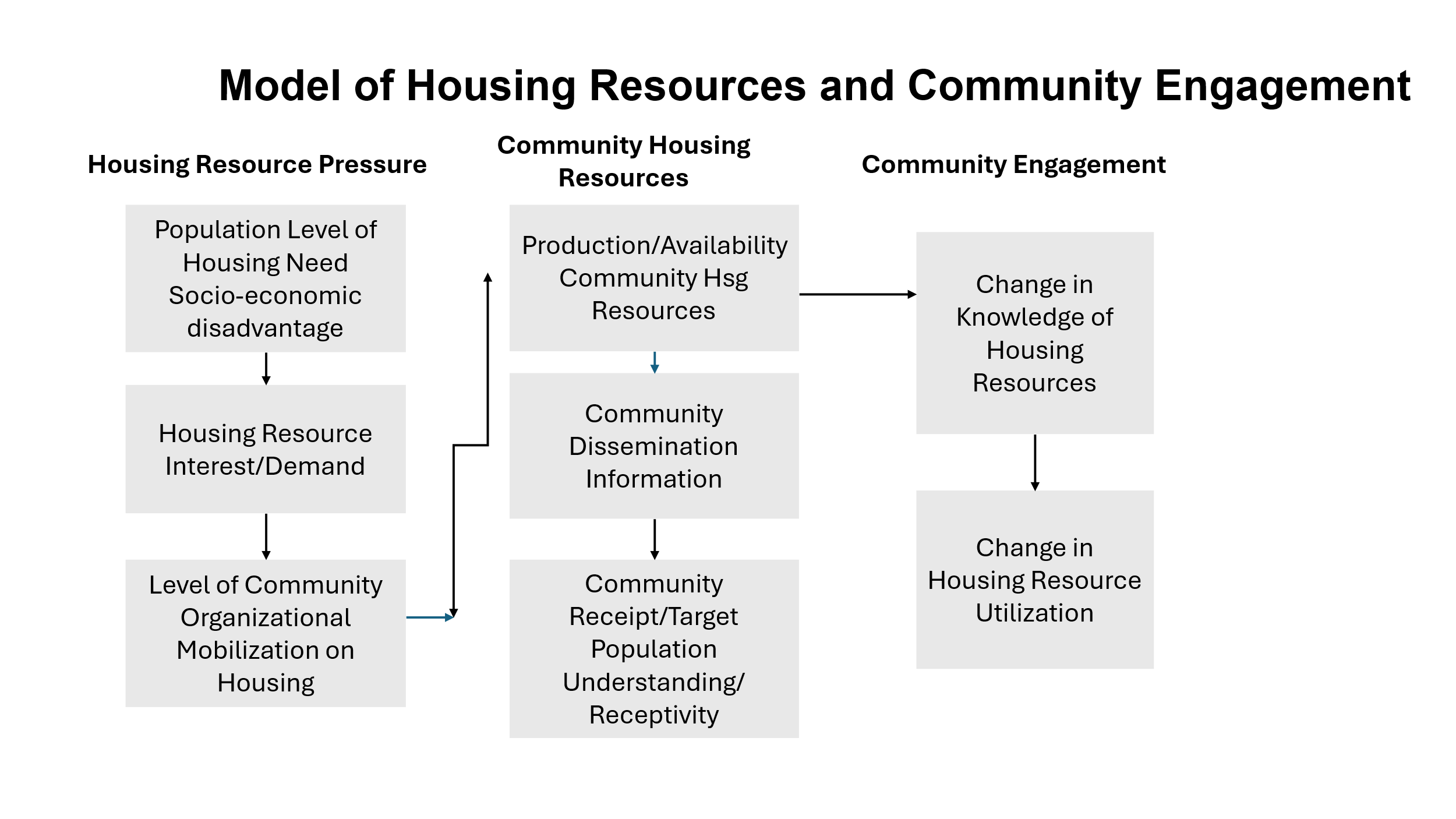
This study explores community engagement and housing, using the case of a Constructive Action project involving education, collaboration and partnerships conducted in the Bronx in 2024. Our model (Figure 1) presents links between forces of population demand, levels of community need, driving interest, and demand for housing resources. Organizational and population mobilization stimulates housing resource production and community-based efforts to increase availability. Dissemination of information assumes citizen understanding and receptivity, which drives knowledge/awareness, community engagement, and utilization of available housing resources.
Figure 1. Model of Housing and Community Engagement
Methodology
The Bronx Defenders, founded in 1997 and a project partner, has been an active leader transforming the ability of low-income people in the Bronx to attain support navigating the justice system. For over twenty years, the organization employed a holistic approach beyond legal representation to address underlying issues bringing Bronx residents into contact with the legal system. The organization defends over 20,000 low-income Bronx residents in criminal, civil, child welfare, and immigration cases and thousands more through community intake and outreach programs (Bronx Defenders, 2023). In 2022, recognizing needs for grassroots community organizing to support its mission, Bronx Defenders established The Bronx Leadership and Organizing Center (BLOC). This partnership between The Bronx Defenders, East Side House, and New Settlement comprises a coalition of 45 Bronx organizations, including churches and advocacy groups, to help residents learn organizing skills, strengthen neighborhood infrastructure, and foster efforts to address intergenerational poverty. BLOC committees include Youth Leadership, Workforce Development, Wealth Generation, and Housing, making decisions based on participant input.
This study describes a 2024 case when the Center collaborated with Metropolitan College of New York, based in Manhattan and the Bronx, on a public administration graduate Constructive Action project. Constructive Action (CA) and Purpose-Centered education are the core of an educational methodology launched by Audrey Cohen (1993), the college founder, aims to transform the education process for adult learners from their traditional role as passive knowledge recipients to central actors driving practical strategies to advance change. Purpose-centered education charges learners with the task of identifying “Purposes” deemed significant and shaping real-world strategies for reaching goals. This year-long three semester, student-led Constructive Action Purpose seminar project, involved working with BLOC on formulation of a community needs assessment, including problem identification, research design, data gathering, and analysis of perceptions of community engagement related to housing concerns of Bronx constituencies, the target of BLOC work, using a small mixed-methods qualitative and quantitative approach. Students were instructed to consult with the field supervisor throughout the process. Data in this case explored the following hypothesis:H1: If Bronx residents have access to more housing resources offered by community organizations, readiness for community engagement will increase.
H1o: Having access to more housing resources offered by community organizations will not affect the level of readiness for community engagement in the Bronx.
During the first stage of initial needs assessment, qualitative data collection involved verbal invitations to BLOC housing committee members, with scheduling of Zoom interviews following acceptance and informed consent with two BLOC members from organizations working on housing in the Bronx. The interviews that were recorded and transcribed involved semi-structured questions assessing motivation, current state, needs, challenges, and practical strategies associated with fostering Bronx housing related community engagement. The first question asked the respondent to recall the event that made them realize they needed to act regarding the housing situation in the community, they were next asked about concerns the Bronx community currently faces regarding housing, whether they are satisfied with the level of engagement in the community and how community members are presently involved in addressing housing issues. Additional questions explored obstacles community members encounter when attempting to participate in community engagement activities related to housing, practical approaches for engaging non-English speakers as well as approaches proven to be most successful for involving community members in discussions about housing concerns. The interviews were analyzed following student instruction about content analysis, with follow-up coding of complete thoughts organized into thematic groupings (see Table 3).
Following this, to further assess housing engagement and Bronx public sentiment, a Likert-scale survey and QR code flyer was disseminated to a convenience sample of pedestrians in high-traffic Bronx areas, including subway stations, shopping plazas and public libraries, to explore perceptions of community engagement around housing and knowledge of community-based organizations that provide housing resources (see questions Table 1 and 2). Of 32 respondents, 93.75% self-identified as Bronx residents and 6.25% as housing advocates. The Polystat program (Nufrio, 2005) was used for analysis with responses assessing levels of agreement or satisfaction with a series of statements coded from 5 (strongly agree) to 1 (strongly disagree).
The Constructive Action project phase following needs assessment involved student instruction about project implementation with the focus moving to work on design of a small, 10- week pilot action plan that involved development of a project timeline and logic model. This formed the basis for work on plan implementation in the field with the final phase of the year-long Constructive Action process involving instruction on evaluation and engagement of students in development of an evaluation design, followed by creation of an evaluation report and long-range proposal for funding as well as final conclusions and recommendations.
Limitations of the Constructive Action process include complexities of overlaps of fieldwork and formal class instruction, with challenges of quick timelines and phase overlaps. Thus, data collected in needs assessment included small convenience samples unlikely to be fully representative of the Bronx target population. The quick movement and overlap of the data analysis and subsequent action planning phases also results in some limitations in implementation because of incomplete synthesis and incorporation of needs assessment findings.
Results
Needs Assessment
Housing and Community Engagement: Advocate Interviews
Interviews (Table 2) in this Constructive Action case first explored perceptions and experiences about community engagement around housing with two individuals involved in housing advocacy in the Bronx housing coalition which served as the base organization for the student field placement.
Table 2. Results housing advocate community engagement themes (n=2)
Both respondents first addressed their original motivations for engagement in housing issues in the community with personal experiences of need and housing instability emerging as important themes. One respondent recounted powerful memories related to losing their home in childhood, which motivated their eventual empowerment and activism around housing. Another pointed to widespread experiences of housing instability among a large number of friends, frequent visibility of homelessness in the community and subsequent secondary impacts of individuals robbing and stealing.
Regarding concerns related to housing, both respondents emphasized significant challenges posed by lack of affordable housing options and barriers to accessing housing in the Bronx. They noted impacts of policies like the 40-times rent income eligibility requirements commonly used by landlords, problems with landlords charging higher rents targeting large numbers with shelter subsidies able to pay more than the working class, movements of higher income individuals into low-income communities, misplacement of low-income housing in areas not majority low-income, and poor neighborhood quality.
Both respondents expressed dissatisfaction with current levels of community engagement around housing among Bronx residents with displeasure around difficulties in mobilization and the community’s tendency to engage in discussions and planning, without real action or follow-up. While acknowledging the importance of community engagement around housing, both identified barriers, including time constraints, especially for the working class, the clash of individualistic versus communal culture, need for increased ethics dealing with elected officials and problems with necessary resources and funding. Suggestions included better promotional strategies to get more people engaged, strategies to hold elected officials accountable, creating accessible platforms for dialogue through town hall and community meetings, building leadership at building and block levels, engaging youth by offering incentives, including stipends, job opportunities, trips, leveraging influential celebrities to generate interest, and acknowledging the value of people’s time. Both respondents highlight challenges engaging non-English speakers in housing decision-making, suggesting increasing bilingual staff and use of devices with translation technology.
Community Housing Engagement Survey
Next, a community “street level” survey explored Bronx citizen perspectives concerning borough community engagement around housing (Table 3). In response to a question about satisfaction with levels of community engagement around housing in the borough, the mean score of thirty-two respondents was 2.125, indicating satisfaction was relatively low. Only one (3.12%) was highly satisfied, with 25% having no opinion and the vast majority (16 or 71%) dissatisfied with borough levels of engagement. In contrast, a substantial majority of respondents, 22 (68.75%), strongly agreed individuals needed to work together to advocate for change to solve housing issues in the borough, with none disagreeing or strongly disagreeing, indicating widespread support for joint efforts for change.
Table 3. Citizen perception of community-based housing engagement | |||
N=32 | Mean | S.D | C.V |
Satisfaction with the level of community engagement in the Bronx. | 2.125 | 0.870 | 0.409 |
Everyone must work together to advocate for change to improve housing conditions. | 4.375 | 0.941 | 0.215 |
Community involvement will help residents influence housing policies and decisions within our city. | 4.062 | 1.014 | 0.249 |
Personal participation in community engagement activities related to housing issues in my area. | 2.687 | 1.424 | 0.529 |
Interest in greater involvement with community activities related to housing. | 3.812 | 0.997 | 0.261 |
While just over half (17 individuals or 53.125%) strongly agreed community involvement will help residents influence housing policy, a slightly lower but almost equal number, fifteen, (46.875%) were neutral while none disagreed or strongly disagreed. Regarding interest in greater future engagement, 13 individuals (40.625%) strongly agreed, just over half (19 or 59.375%) were neutral and no one disagreed. For personal participation in community housing engagement activities, less than a quarter (seven or 21.875%) strongly agreed, with over half (53%) disagreeing, indicating a tendency toward lack of direct personal experience.
Housing Resources
Another question (shown in Table 4) explored public knowledge of community-based organizations that provide housing resources. Of 32 respondents, only two (6.25%) strongly agreed and no one agreed, over half (19 or 59.375%) were neutral, and eleven (34%) had no knowledge about these organizations. Regarding familiarity with accessing housing resources provided by Bronx community-based organizations, only two out of 32 respondents (6.25%) strongly agreed, none agreed, just over half (seventeen or 53.125%) were neutral and thirteen (40.6%) disagreed they were familiar with accessing these resources.
Action Plan and Implementation
The next Constructive Action project phase involved design of a pilot action plan and student implementation of measures to address identified problems identified in the previous data. The formulated plan goal was to increase Bronx community awareness and engagement with housing resources with the objective of disseminating 500 copies of informational materials on housing-related resources through at least 10 community and faith-based institutions and handouts to local businesses and pedestrians. A second goal was to increase BLOC’s online visibility and outreach. The target 10-week implementation process involved student use of a “tracking grid” monitoring project steps by documenting tasks planned and completed, weekly challenges, and lessons learned supplemented by a diary called “logs,” recording the implementation phase.
Brochures were designed with a comprehensive list of Bronx nonprofit organizations and available city and state housing initiatives and array of housing supports, including homelessness prevention, Section 8, and rental assistance. By late spring 2024, the project distributed 399 brochures at eight Bronx locations, including two colleges, two health centers, a church, mosque, and handouts at two pedestrian areas. Implementation was organized and monitored through the tracking grid, documenting numbers and distribution places. Working with BLOC, the second project goal involved a social media content strategy, and publishing weekly posts on platforms related to benefits and community engagement opportunities.
The initial plan was to redesign the Bronx Defenders website, adding a comprehensive housing resources section. Instead of moving forward with extensive changes to the website structure, the team pivoted to a more streamlined solution due to challenges with approvals for a significant website overhaul. Instead, a simple link was added to the website directing users to the online housing resource brochures, providing access to the resources without the complete website redesign. Social media stories were posted that emphasized importance of community engagement. This compromise ensured Bronx residents could access important housing information, albeit through a different avenue than initially planned. Due to logistical delays, the social media strategy was compressed into a more concentrated posting schedule on Instagram Stories and overall project implementation extended to 12 weeks not ten. Stakeholders included graphic design volunteers, the BLOC communication team, field supervisor, community stakeholders for distribution, including Bronx faith, educational organizations, and residents from various backgrounds.
Evaluation
The final project evaluation phase obtained feedback from community individuals who received the projects information about housing resources at two Bronx distribution locations. Table 2 shows responses to questions posed about the project’s impact. Of 15 invited participants to the survey, the response rate was 10 (66.7%).
Table 3. Assessment of Housing Resources on Community Engagement and Knowledge
N=10 | Mean | S.D | C.V | ||
Awareness of those available housing resources in the Bronx before receiving the informational materials. | 1.8 | 0.788 | 0.438 | ||
After receiving the informational materials, I feel more informed about housing resources in the Bronx. | 4.6 | 0.516 | 0.112 | ||
I intend to utilize the housing resources provided in the informational materials in the future. | 4.8 | 0.632 | 0.131 | ||
Knowledge of housing resources will increase my willingness to engage in housing justice efforts in the Bronx. |
| 0.516 | 0.143 | ||
Respondents were asked about prior awareness of available Bronx housing resources before receiving the project’s housing brochures. Of 10 respondents, the majority, eight (80%), were previously not aware of the resources, with two neutral. All ten, however, reported that they felt more informed after the intervention and all were satisfied with both material content and presentation, with a substantial majority (80%) expressing high satisfaction and willingness to recommend the materials to others. Regarding willingness to engage in future housing efforts, six (60%) agreed, four (40%) were neutral, with none disagreeing. The responses compare favorably with the same pre-pilot project intervention survey question, where 40% expressed interest and 59% were neutral about interest in future engagement around housing. However, only three agreed that they had seen the social media stories disseminated through the project and the mean score for this question was 2.2, indicating low overall awareness of thebloc22’s social media stories, indicating the social media efforts needed changes for expanded reach.
Diary reflections on project implementation suggest brochure creation and housing resource identification worked well, with critical housing-related resources in the Bronx identified early, creating a robust project foundation from effective volunteer and team coordination Collaborating with a freelance graphic designer for brochure content and working closely with the communication team to revise schedules showcased the team’s ability to utilize resources effectively and work collaboratively. Although adjusted, the comprehensive social media strategy provided a clear plan and ensured a structured approach once approvals were received. Challenges included communication, approval dependencies and unforeseen logistical delays impacting project personnel, and needs to extend the project timeline by two weeks. Developing robust contingency plans would enhance project resilience. Timely adjustments and flexibility were essential, but comprehensive backup plans for scenarios like overbooked printing services could further help adhere to the original project timeline and prevent setbacks.
Discussion
Low-income residents in the Bronx face a myriad of housing issues, including rent burden, possible homelessness or eviction, and policies creating fractured communities. The study demonstrates that community engagement around housing and increasing awareness and access to available resources for support, is complex, but remains a critical need. Initial interviews with housing advocates confirm findings from the public survey regarding general dissatisfaction with current levels of community engagement around housing in the borough. The interviews also highlight that personal experiences of trauma around housing have the power to motivate individual choices to become actively engaged on the issues.
While many in the Bronx public surveys understand the importance of housing engagement, low levels of actual engagement and knowledge of housing resources, support and locally active organizations exist, despite efforts of dynamic community organizations. While many responding to the small public survey were ambivalent about their own future intention to engage in housing issues, a solid core showed interest. Because housing challenges are salient in the community, it was clear that strategies to increase awareness of resources to alleviate housing stress need improvement to be effective.
Advocate interviews highlight interesting differences in challenges related to housing engagement between population groups, including those with housing subsidies, the unemployed and working class who may experience both subsidy and engagement barriers. To engage more residents future efforts must embrace approaches sensitive to these differences by measures responsive to working class time pressures, community diversity of culture and language, and leveraging innovation and inclusion through new technologies. While this study population was quite small with limitations on Bronx population representation, the 10-week pilot intervention and evaluation suggests rejection of the null hypothesis and that organized community stakeholders have at least some potential to positively influence community housing engagement readiness through increasing access to housing resources. However, targeted initiatives with this specific aim need careful follow-up planning and administration to move forward successfully.
Conclusion
This hands-on, collaborative case achieved important goals. The Constructive Action process improved student empowerment and understanding of practical aspects of problem identification, research methodologies, project design, implementation and evaluation, and also enhanced Bronx community stakeholder knowledge and changemaking ability. While the data collection methods were exploratory and the project implementation period was limited in scope, the project revealed interesting facets of community engagement useful for future consideration. Because of the urgency of the current housing crises in New York City stimulating engagement tailored to housing supports and barriers must rapidly overcome societal complacency about a system too complex to be responsive to individual needs. The study suggests economic disparities within low-income communities both stimulates and hinders participation, with residents balancing desires for engagement with challenges of time, resources, modes of communication and complex relationships with political leaders.
While this study finds positive impacts of dissemination of housing resource information on community engagement intention, future research should further examine links between engagement readiness, intention and the resulting follow-up action. This should include exploring variations in types and timing of housing resource dissemination, as well as the other engagement strategies recommended in the interviews including experiments with accessible platforms for dialogue, youth and community incentives, celebrity influencers and block level leaders. Future research also should work with larger target population samples differentiated by employment status, age, gender, race, ethnicity, literacy and computer accessibility. Variations in housing engagement strategies used by relevant community-based housing organizations is another interesting avenue for investigation.
This study confirms that creative educational projects linking theory and practice such as this Constructive Action initiative shows the promise of building strategic collaboration between dynamic community partners such as the Bronx Defenders and educational institutions to improve holistic approaches to community empowerment and learning.
References
Adams, B., & Eaton, J. (2016). Facilitating mental health awareness and community engagement. chrome-extension://efaidnbmnnnibpcajpcglclefindmkaj/https://www.mhinnovation.net/sites/default/files/content/document/Community%20Forums%20report_0.pdf
Aitken, M., Haggett, C., & Rudolph, D. (2016). Practices and rationales of community engagement with wind farms: awareness raising, consultation, empowerment. Planning Theory & Practice, 17(4), 557-576.
Arnstein S. (1969) A ladder of citizen participation. Journal of the American Planning Association, 35 (4), 216-224.
Bergstrom, D., Rose, K., Olinger, J., & Holley, K. (2014). The sustainable communities initiative: The community engagement guide for sustainable communities. Journal of Affordable Housing & Community Development Law, 22(2), 191–211. http://www.jstor.org/stable/24389776
Bronx Borough President (2022) Strategic policy statement. https://bronxboropres.nyc.gov/2022/09/06/strategic-policy-statement-of-bronx-borough-president-vanessa-l-gibson/
Bronx Defenders (2023) About us. https://media4.manhattan-institute.org/wp-content/uploads/costs-and-benefits-of-source-of-income-discrimination-laws.pdf
Bryer, T. A. (2013). Designing social media strategies for effective citizen engagement: case example and model. National Civic Review, 102(1), 43-50.
Cassidy, M., & Currie, J. (2023). The effects of legal representation on tenant outcomes in housing court: Evidence from New York City’s Universal Access Program. Journal of Public Economics, 222, 104844.
Ceasar J., Peters-Lawrence M.H., Mitchell V., Powell-Wiley T.M. (2017) The Communication, Awareness, Relationships and Empowerment (C.A.R.E.) Model: An effective tool for engaging urban communities in community-based participatory research. International Journal of Environmental Research and Public Health. 14(11):1422. https://doi.org/10.3390/ijerph14111422
Cohen, A. (1993). A new educational paradigm. Phi Delta Kappan, 74(10), 791-795.
Connor, D. M. (1988). A new ladder of citizen participation. National Civic Review., 77, 249-257. http://dx.doi.org/10.1002/ncr.4100770309
Glock, J. (2024, April). A solution in search of a problem: The costs and benefits of source of income discrimination laws. Manhattan Institute. https://media4.manhattan-institute.org/wp-content/uploads/costs-and-benefits-of-source-of-income-discrimination-laws.pdf
Hashagen, H. (2002). Models of community engagement, Scottish Community Development Centre,
International Association for Public Participation (IAP2) (2018). Core values, ethics, spectrum. IAP2 Spectrum of Participation. https://www.iap2.org.au/Home
Kasala, V., & Smatanova, K. (2019, September). Community engagement as a sustainable tool in transforming mass housing urban structures. Case study of Petržalka estate, Bratislava, Slovakia. In IOP Conference Series: Materials Science and Engineering, 603 (3), 032063. IOP Publishing.
Kabir, H. (2006). Citizen and community engagement models and examples. City of Ottawa’s Neighborhood Planning Initiative with support from Infrastructure Canada. https://carleton. ca/cure/fr/wp-content/uploads/Huma yunsfinaNPIlOct2006. pdf.
Khatibi, F. S., Dedekorkut-Howes, A., Howes, M., & Torabi, E. (2021). Can public awareness, knowledge and engagement improve climate change adaptation policies? Discover Sustainability, 2, 1-24.
Konsti-Laakso, S. and Rantala, T. (2018). Managing community engagement: A process model for urban planning. European Journal of Operational Research, 268 (3),pp. 1040-104 https://www.researchgate.net/publication/321695616_Managing_community_engagement_A_process_model_for_urban_planning [accessed Aug 17 2024].
Lee, M. J., & Levine, P. (2016). A new model for citizen engagement. Stanford Social Innovation. Review, 14, 40-45.
McGee, S. (2009) Understanding best practices for community engagement in municipal contexts. [Master’s Thesis, Wilfrid Laurier University]. 943. https://scholars.wlu.ca/etd/943
McHugh M., Morawski M. (2016) Immigrants and WIOA comparison of sociodemographic characteristics of native and foreign born adults in Bronx County New York. Migration Policy Institute. https://www.migrationpolicy.org/sites/default/files/publications/WIOAFactSheet-BronxCountyNY-FINAL.pdf
Merriam Webster (2024) Engagement. https://www.merriam-webster.com/dictionary/engagement
New York City Department of City Planning (2023, February) Statement of community district needs and community board budget 2024. Bronx Community District 3. https://communityprofiles.planning.nyc.gov/bronx/3
New York City Housing Authority. (2024) Need housing. Eligibility for Section 8 Housing Choice Vouchers Program. https://www.nyc.gov/site/nycha/eligibility/eligibility.page
New York City Mayor’s Office of Immigrant Affairs (2023). Annual report on New York City immigrant population and initiatives of the office. https://www.nyc.gov/assets/immigrants/downloads/pdf/MOIA-Annual-Report-2023_Final.pdf
New York City Planning Department (2024, December 5) City of Yes for housing opportunity. https://www.nyc.gov/site/planning/plans/city-of-yes/city-of-yes-housing-opportunity.page
New York City Police Department. (2024, Oct 13) Comstat 31 (41). Bronx. https://www.nyc.gov/assets/nypd/downloads/pdf/crime_statistics/cs-en-us-pbbx.pdf
New York City Comptroller (2024, December 15) Annual state of the city’s economy and finances. https://comptroller.nyc.gov/reports/annual-state-of-the-citys-economy-and-finances-2024
New York City Rent Guidelines Board (2024 April 11) 2024 income and affordability study. https://rentguidelinesboard.cityofnewyork.us/wp-content/uploads/2024/04/2024-IA-Study.pdf
New York University Furman Center (2020), State of New York City’s housing and neighborhoods in 2020. https://furmancenter.org/stateofthecity/state-of-the-city-2020
New York University Furman Center ( 2022) Neighborhood profiles, The Bronx. Racial and ethnic composition of the Bronx. https://furmancenter.org/neighborhoods/view/the-bronx#:~:text=Demographics,-Indicator&text=In%202022%2C%20there%20were%20an,and%208.3%25%20identified%20as%20White.
Macfie, B., Nufrio P. (2006) Applied statistics for public policy. Routledge.
Parés, M., Ospina, S. M., & Subirats, J. (2017). South Bronx: a whole community fighting social exclusion. In Social Innovation and Democratic Leadership (pp. 119-147). Edward Elgar Publishing.
Point2Homes (n.d.). Bronx New York market trends. https://www.point2homes.com/US/Average-Rent/NY/Bronx.html
Queensland Government (2006). Engaging Queenslanders: An introduction to community engagement.http://www.getinvolved.qld.gov.au/share_your_knowledge/resources/documents/pdf/Intro_C E.pdf#search=’Engaging%20queenslanders%20%3A%20An%20Introduction%20to%20%5C
Rocha, E. M. (1997). A ladder of empowerment. Journal of Planning Education and Research, 17(1), 31–44. https://doi.org/10.1177/0739456X9701700104
Teater, B. (2009). A place to call “home”: Exploring the experiences of Section 8 housing choice voucher program recipients in their efforts to find housing. Families in Society, 90(3), 271-278.
Tsigler Law (2024, March 20) Manhattan crime rate and statistics. https://www.tsiglerlaw.com/blog/manhattan-crime-rate.
U.S. Census Bureau (n.d.) . Quick facts, Bronx County. American Community Survey 2022. https://www.census.gov/quickfacts/fact/table/bronxcountynewyork,newyorkcitynewyork/HSG010221
Weisman Center for International Business (2021). New York City foreign born population by country of birth 2019 estimates. Baruch College https://www.baruch.cuny.edu/nycdata/population-geography/foreign-birthcountry.htm
Wiedemann, P. M., & Femers, S. (1993). Public participation in waste management decision making: Analysis and management of conflicts. Journal of hazardous materials, 33(3), 355-368.
Young, S. F., Steelman, L. A., Pita, M. D., & Gallo, J. (2024). Role-based engagement: scale development and validation. Journal of Management & Organization, 30(2), 248-268.