College Debates as a Form of Civic Engagement
Introduction
Affective polarization, the gap between positive feelings towards one’s own political party and negative feelings towards the opposing party, has risen substantially in recent years (Druckman & Levy, 2022). Research indicates that social network organization is one facet driving polarization. Essentially, individuals create virtual echo chambers by both linking with similar people (Santos et al., 2021) and disconnecting from those with whom they do not agree (Tokita et al., 2021). This effectively creates homogenous informational and social networks that reduce exposure to challenging viewpoints and simultaneously increases outgroup hostility (Tokita et al., 2021).
At the same time, self-censorship, the public repression of one’s beliefs and opinions, appears to be reaching an all-time high (Gibson & Sutherland, 2023; Wilson, 2022). Results from a 2020 nationally representative sample indicate that 46% of Americans reported being less free to speak their minds than they used to be (Gibson & Sutherland, 2023). Within colleges and universities specifically, 2021 data from the Foundation for Individual Rights in Education indicate that 21% of students self-censor on campus either “fairly often” or “very often.” The design of some of these surveys has been criticized (see, e.g., Wilson 2022), but irrespective of whether the data are a good proxy for self-censorship, the anecdotal stories of student censorship are prevalent. For example, in March 2022, Emma Camp, a student at University of Virginia, published a guest essay in the New York Times titled “I Came to College Eager to Debate. I found Self-Censorship Instead.” She elaborates,
A friend lowers her voice to lament the ostracizing of a student who said something well-meaning but mildly offensive during a student club’s diversity training. Another friend shuts his bedroom door when I mention a lecture defending Thomas Jefferson from contemporary criticism. His roommate might hear us, he explains. I went to college to learn from my professors and peers. I welcomed an environment that champions intellectual diversity and rigorous disagreement. Instead, my college experience has been defined by strict ideological conformity. Students of all political persuasions hold back — in class discussions, in friendly conversations, on social media — from saying what we really think.
This self-censorship further aggravates political divides. Notably, when political division is high, consequences include decreased social trust and both acceptance of, and dissemination of, misinformation (Hetherington & Rudolph, 2015; Osmundsen et al., 2021). Though there are several possible remedies by which to counter these divides, the general prescription is to reduce stereotypes and recognize commonalities (Druckman & Levy, 2022). One strategy that has emerged on college campuses is the Braver Angels debate format. In this paper we posit that exposure to the Braver Angels debate format, a non-competitive experience in “collective truth” finding, can counter self-censorship and polarization by allowing for a free exchange of ideas focused on carefully examining issues through active listening and civil discourse. These debates have the potential to foster personal development in the areas of intellectual humility, intellectual curiosity, and empathy. Furthermore, debate participation is a form of civic engagement, defined as “working to make a difference in the civic life of one’s community” (Youth.gov, 2024). Debate participation encompasses the four constructs of civic engagement: civic action (i.e., being involved in activities that benefit the community), civic commitment/duty (i.e., making positive contributions to society), civic skills (i.e., having an involvement in politics, society, and democracy), and social cohesion (i.e., establishing a sense of trust or reciprocity with others) (Youth.gov, 2024).
This paper provides an overview of one campus program that utilizes Braver Angels debates. We begin with a brief review of literature supporting debate and civil dialogue as democracy-promoting practices. Next, we explain the specific characteristics of a Braver Angels debate. We then transition to how our campus got involved with Braver Angels debates and how we established the Virginia Military Institute (VMI) College Debates and Discourse (CD&D) Program. We elaborate on our program’s initiatives, approach, and objectives. We conclude by providing some preliminary quantitative and qualitative evidence for the CD&D Program’s effectiveness at VMI.
Civil Discourse and Democracy
According to a 2025 joint report from the Center for Information & Research on Civic Learning and Engagement (CIRCLE) and Protect Democracy, 63% of voting-eligible youth have a high regard for democratic principles and generally trust government institutions. Notably though, while these youth generally vote, they are otherwise disengaged from political action. Contrastingly, the remaining 37% of voting-eligible youth surveyed tend to be dismissive or even hostile towards democratic principles and action (Apau et al., 2025).
One mechanism for combatting political complacency (at best) and hostility (at worst) is debate and discourse. There is a rich literature connecting debate to student learning, with outcomes ranging from improved content knowledge to self-confidence and speaking skills (see Zorwick & Wade, 2016). Furthermore, debates, and collaborative dialogues can foster the triad of civic knowledge (e.g., political and historical understanding), civic skills (e.g., critical thinking, media literacy, effective communication), and civic dispositions (e.g., moral responsibility, self-discipline, collaboration) (Roidt et al., 2016; Zorwick & Wade, 2016). In fact, data from a cohort of 6 colleges indicates that students who took part in classes that integrated debate and logical reasoning into their pedagogy reported increases in both civic awareness and skills (Mabrey et al., 2021). Numerous other studies support a connection between civil discourse and the development of civic knowledge, skills, and dispositions, all fundamental components of a democratic society (see Lee & Nasir, 2024).
What is a Braver Angels Debate?
Braver Angels, a non-profit organization focused on bridging the partisan divide, developed the Braver Angels debate format (Braver Angels, 2024). The format evolved and was adopted by the National College Debates and Discourse Alliance, an initiative of three organizations: Braver Angels, the American Council of Trustees and Alumni (ACTA), and Bridge USA. The alliance “teaches students to honor ideological diversity, foster civil discourse on college campuses, and cultivate student and faculty leaders to carry the movement forward” (ACTA, 2024).
Braver Angels debates are best described as non-competitive, non-performative collective searches for truth (ACTA, 2024). They are unlike most political debates and school debate club events with which many of us are familiar. For one, Braver Angels debates are led by a trained facilitator who conducts the proceedings in a light parliamentary style (ACTA, 2024). The debate topic is always phrased as a statement to allow for speeches in the affirmative or negative. Additionally, everyone at the debate is encouraged to speak but no one is compelled to. During the debate, all points of view are invited, and every attendee is considered to be on equal footing. In other words, factors like rank, status, and age are irrelevant.
There are several key features of Braver Angels debates that facilitate civil discourse. First, speeches are short, and the viewpoints must alternate, at least for the first hour of the debate – a speech affirming the debate resolution is followed by a speech in the negative (Braver Angels, 2024). This ensures that a wide spectrum of viewpoints is presented in the debate. Second, every speaker is asked at least two questions by other participants (Braver Angels, 2024). The questioning of presented arguments tends to weed out bad faith arguments and fake news. Third, while a speaker speaks, no one can interrupt, a rule that ensures active listening. Fourth, all questions are directed toward the facilitator, not the speaker; this decreases the heat of the argument because a person has to re-direct their initial reaction toward a third party. This is an essential component of the debate that ensures civil discourse – attack the argument, not the person. Fifth, there is a significant reflective component at the end that allows everyone to think about the how, rather than the what, of the debate.
Critics have expressed concerns about the guiding philosophy and structure of Braver Angels debates. According to Coe (2024), in demonizing polarization, the Braver Angels philosophy effectively privileges political centrism without explicitly recognizing centrism as its own political category. April Holm, associate professor of history at the University of Mississippi, further elaborates on this: “Calls for moderation and civility, combined with denouncing both sides as too extreme, are common in moments of moral and political crisis. But they are not apolitical. They take the focus away from injustice and put it instead on the behavior of those protesting it” (2019). Furthermore, Coe (2024) references multiple means by which polarization can spur civic action and asserts that the interactions inherent to Braver Angels debates foster individual transformation but fail to deliver on collective civic action. Critics also contend that the debate format inhibits expression of genuine feelings by glossing over negative emotions and focusing on reason and moderation. Thus, the debates prioritize connection at the expense of examining hostilities. Finally, since debates focus on preserving social norms through moderated forms of acceptable dialogue, the structure reinforces the voices of those creating the normative rules (i.e., white, upper-middle class).
Even with the above criticisms, we posit that Braver Angels debates do much more good than harm because they provide a rare forum for discussion. Unlike the echo chambers of social media, this forum allows people to hear views that they would otherwise not seek out. Consequently, we propose that these debates “teach students to express their views, frame persuasive arguments, listen deeply, and engage respectfully around the most challenging political and social issues dividing our nation today” (ACTA, 2024). As such, this type of debate program is a clear form of civic engagement with citizens working in a collaborative environment to identify and address issues of public concern. Student debate participants practice civic skills and action by learning to discuss pressing community and societal issues in respectful, non-combative ways. The “rules of engagement” do not disallow for divisive opinions to be expressed; in fact, expressing political or ideological differences is encouraged. All ideas are up for examination and bad faith arguments tend to be scrutinized. As we describe below, the structure of the debates allows for a building of trust and reciprocity, key elements of social cohesion (Youth.gov, 2004). Arguably, this combination, of civic skills, civic action, and social cohesion provides the stepping stones for students to make positive contributions to society, a form of civic commitment/duty (Youth.gov, 2024).
The VMI College Debates and Discourse Program
Beginnings
The VMI campus was first introduced to the Braver Angels organization in 2017 when David Blankenhorn, one of the founders of Braver Angels, was invited as a guest speaker for a conference organized by VMI’s Center for Leadership and Ethics (CLE). Inspired by Blankenhorn’s 2017 visit, in Fall 2021 the CLE conference integrated four Braver Angels debates. The topics were purposefully divisive issues, including vaccine mandates and transgender athletes in sports. Student and faculty leaders from the student-led Building BRIDGES Club, a community service group, were invited to attend the debates with the goal of forming a partnership with the CLE to continue offering Braver Angels debates on campus. Having observed the debates during the conference, the club leadership enthusiastically agreed to the partnership.
Establishing and Expanding the VMI program
The Building BRIDGEs Club and the Center for Leadership and Ethics started collaborating on organizing one Braver Angels debate per semester after that conference.
The first college-wide debate at VMI was held in Spring 2022. At that time, the VMI team opted for a societal issue that would be of particular interest to students at a military college: “Should women be assigned combat roles?” Approximately 25 people attended.
In Fall 2022, VMI was invited by the National College Debates and Discourse Alliance to become a community of practice for a John Templeton Foundation Grant. That process led to the formal establishment of the VMI College Debate and Discourse (CD&D) Program and allowed faculty and cadet fellows to get training on chairing debates, drafting debate resolutions, and engaging with strategies to establish and build a community of practice. After reasonable success with a couple small debates on societal topics, in Spring 2023, the VMI CD&D team selected a debate topic that was highly internal to the school: the divide between NCAA athletes and non-athletes. Nearly 100 people attended the event including student athletes, non-athletes, coaching staff, faculty, and members of the administration to include the school’s superintendent. It was deemed a productive debate because people heard “the other side” and, in most cases, learned something new. As the conversation continued, more and more hands went up and more students wanted to share an opinion. It was a true community dialogue, which left many students, faculty, and staff, eager to participate in future discussions.
After the success of the athlete/non-athlete debate, the VMI CD&D team reached out to faculty and staff members at neighboring colleges to put together an intercollegiate planning committee. Located in Lexington, VA, VMI directly abuts Washington & Lee University (WLU) and is within 10 miles of Southern Virginia University (SVU) and Mountain Gateway Community College (MGCC). By Fall 2023, the VMI CD&D Program led the way in establishing the first intercollegiate Braver Angels debate in the nation, a discussion on book banning, a topic which had personally reached the community. The diversity of viewpoints was further augmented by the participation of the four schools, each of which has different student body characteristics (VMI is a military college; WLU is a private school with significant Greek life; SVU is a school that embraces the values of the Church of Jesus Christ of the Latter-Day Saints; and MGCC is a non-residential community college).
Expansion continued in Fall 2024 at which point community members, in addition to students and intercollegiate affiliates, were invited to attend a debate on immigration, a topic chosen for its relevance to the then-upcoming presidential debate. Informal feedback from both student and non-student attendees indicated that the inter-generational component of this debate, made possible by community member and student attendance, was incredibly valuable.
To build a community of practice at VMI, the VMI team launched several initiatives beyond the college-wide debates. In 2023-2024, student fellows led miniature debates over lunch. These debates were much smaller in size, often attended by 8-10 people, and shorter in length. However, monthly lunch debates allowed for continued building of the program through sustained interest/activities and by offering a different meeting time. While college-wide debates are held in the evening, a time not conducive to some schedules, lunch debates can be easier for students, staff, and faculty to attend.
The following year, recognizing that civil discourse entails more than just debates, the VMI CD&D team altered the lunch debate program to Food for Thought Conversations. These occur monthly over the lunch hour; however, rather than debate, individuals are encouraged to answer questions on listening cards. The team is using the listening cards developed by “My Neighbor’s Voice,” a non-profit organization whose mission it is to “create purposeful and productive community connections” (My Neighbor’s Voice, 2024).
Finally in September 2024, the VMI CD&D Program partnered with the national CD&D Alliance and the State Higher Council of Education for Virginia (SHCEV) to host an in-person five-hour training session for faculty, staff, and students from across Virginia. This training was inspired by a shorter virtual session that the VMI team put together jointly with SCHEV in March 2024.
The VMI Team
VMI relies on three faculty/staff fellows and four student fellows. The one staff member is affiliated with VMI’s Center for Leadership and Ethics (CLE) while the two faculty fellows advise the Building BRIDGES student club and work in different academic departments. This straddling of disciplines, as well as the academic and professional aspects of the college, is key to ensuring success. The CLE provides a homebase for the program that is rich with programmatic and marketing support, while having faculty in academic departments allows for more direct outreach to students. The faculty/staff fellows put out a call for applications each spring, which entails an online application and interview process. Two of the student fellows are generally seniors while the other two student fellows are juniors or sophomores. This staggering of class years is intentional and allows for a mentoring relationship among the students; younger fellows learn from their senior peers and eventually take over that leadership role and mentor the next cohort of students. Students tend to learn many skills by doing, which is why the staggering of class years is important.
Student responsibilities include brainstorming debate topics, advertising events across campus, identifying opening speakers, assisting with research protocol instructions for the Templeton Grant, and chairing/moderating debates. The latter skill is supported through training from the national CD&D Alliance. Students gain skills in communication, marketing, and teamwork. Furthermore, they are exposed to a diverse array of people and ideas, expanding both their informational and social networks. While members from the national alliance are routinely available to travel and chair debates across the country, the national alliance also coordinates trainings for students and faculty to facilitate their own debates. Members from the national team routinely check in and provide as-needed support. Thus far, grant funding has paid for both faculty and student stipends.
VMI CD&D Program Objectives
As mentioned previously, the national CD&D Alliance was formed to honor ideological diversity and foster civil discourse on U.S. college campuses (ACTA, 2024). In attempting to achieve these larger objectives, the VMI CD&D team has identified a number of other helpful skills that the program seeks to hone. We see immediate alignment between these program outcomes and the civic engagement constructs of civic skills and social cohesion (Youth.gov).
- Listening skills: During the debates, attendees may not interrupt a speaker; therefore, individuals are encouraged to listen with genuine engagement rather than simply think of the next thing they will say.
- Listening does not mean agreeing: In addition to listening itself, debates help demonstrate that sharing an opinion does not mean imposing your beliefs or trying to change someone’s mind. Similarly, it is possible to listen to viewpoints with which you may not agree. Listening skills are also emphasized in the context of leader development at VMI. Good leaders are good listeners.
- Public speaking: All debate attendees are invited to speak. Speeches need not be equipped with research and data but can be based on personal experiences and emotions.
- Personal expression: The Braver Angels format allows for people to honestly express their opinions in a structured space. The debate format, including a trained moderator, provides built-in guard rails, even when discussing highly controversial topics.
- Argument formulation: Individuals are encouraged to express their viewpoints. Furthermore, coherent, well-articulated points made in good faith tend to be received more positively than unfounded ramblings.
- Empathy: Debates personalize contact (Batson & Ahmad, 2009), bringing individuals with different viewpoints together in the same space. Importantly, intergroup contact can decrease levels of hostility and prejudice among groups) via increased perspective-taking and empathy (Pettigrew & Tropp, 2008).
- Emotion regulation: Exposure to diverse viewpoints can lead to feelings of dysregulation or discomfort (Ford & Feinberg, 2020). As Ford and Feinberg (2020) point out, certain emotion regulation strategies may be effective in decreasing negative feelings, but they simultaneously result in apathy and thereby undermine political action. We speculate that the debate format provides a positive space for confronting these emotions and working to regulate them in a productive manner.
- Intellectual humility: To have intellectual humility is to acknowledge the limitations of one’s knowledge and question how they came to their own beliefs. Research finds that mastery-focused classrooms that emphasize learning for learning’s sake, as opposed to performance-focused classrooms that stress competence, improve students’ intellectual humility (Porter et al., 2022). Arguably, the objectives of the Braver Angels debate format are in line with a mastery-focused environment.
- Compromise and Collaboration: Debates do not end with a winning side and losing side; rather, everyone works together to develop a deeper understanding of the issue. This type of collective truth seeking helps foster a healthy democracy.
In the context of the debates, the VMI team has also adopted the concept of brave spaces as opposed to safe spaces. The team was first introduced to the concept of “brave spaces” during a training on diversity and inclusion. Upon further research of the concept, the team focused on the rationale for that concept provided by Arao and Clemens (2023): “It became increasingly clear to us that our approach to initiate social justice dialogue should not be to convince participants that we can remove risk from the equation, for this is simply impossible. Rather, we propose revisiting our language, shifting away from the concept of safety and emphasizing the importance of bravery instead, to help students understand – and to rise to – the challenges of genuine dialogue” (p. 136). In other words, while “safe spaces” protect individuals from criticism or emotional harm, “brave spaces” allow for a diversity of opinions to be expressed. A brave space seemed to be well-aligned with the objectives of a Braver Angels debate, which allows for multiple viewpoints to be both expressed and critically examined, while doing so in a structured fashion (i.e., through a trained moderator; listening before responding).
How are Program Objectives Achieved?
Choosing a Resolution
As stated above, a debate resolution is always phrased in the form of a statement as this allows for speeches in the affirmative or negative. Resolution choice is extraordinarily important to the success of a debate. Effective resolutions should not only attract the interest of potential attendees but should invite a diverse array of opinions.
Resolution selection begins with a brainstorming session. The debate team works together to generate a list of possible topics and issues that would be of interest to their population. The national CD&D Alliance publishes a list of debate resolutions, which can be very helpful in this process. In the VMI program, the team chooses five possible debate topics and then researches interest level and diversity of opinion on each topic in the VMI community using a Qualtrics survey. All students are invited to respond to the voluntary survey which asks them to rate their level of interest in each topic and where they stand on the particular resolutions (strongly disagree to strongly agree). It is possible that some topics are of great interest to the study body, yet students all hold very similar positions. In this situation, it is not advisable to proceed with a debate. The best resolutions garner both high interest and a near equal split in opinion.
Debate resolutions are often formed around current societal issues (e.g., immigration, social media, artificial intelligence, international affairs), but resolutions can also be tailored to the particular college population. For example, as a military college, VMI prides itself on a high degree of student leadership within the Corps of Cadets. A recent debate focused on the question of whether student leaders truly make decisions or if there is too much administrative oversight (resolution: “The Corps truly leads the Corps”). This debate was intentionally designed around a VMI-specific issue to attract a wide array of students. Once students attend one debate, they tend to return for more. Consequently, these internal debates can be quite effective on an annual basis as they attract new students, faculty, and staff to the program. See Figure 1 for a list of topics at VMI debates.
Set up of the Room
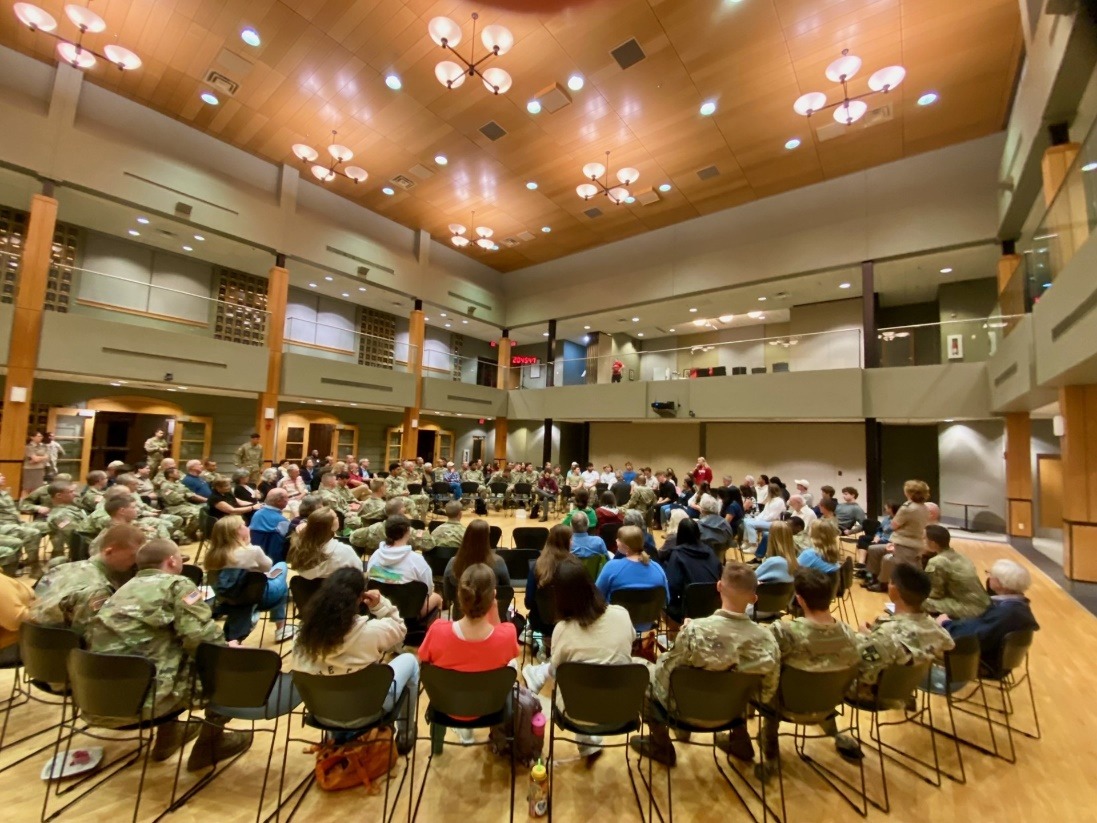
The VMI team sets up the room as a circle. Speakers go to the middle of the circle, which in itself shifts the mindset of the speaker and the audience. A faculty participant from a different school recently remarked at one of the VMI debates that he could see elements of restorative justice and peacemaking circles in the debates. This setup, which allows everyone to see each other, helps build community and rapport (see Figure 2 for photos of the room set up).
Opening speakers
All Braver Angels debates start with two to four opening speakers who are briefed before the debate. The opening speakers are a spark plug of the debates (ACTA, 2024); they model the willingness to engage and the openness to a conversation. They have a slight advantage over everyone else in that they prepare their full speeches ahead of time. However, they are never told what to say. The team only ensures that we have an equal number of opening speakers for and against the resolution.
Structure of the Debate
The debate begins with instructions by the Chair who serves as the moderator. The Chair first invites an opening speaker in support of the affirmative to speak for 3-4 minutes, followed by questions to the speaker. Next, the Chair recognizes an opening speech in the negative, followed by questions to that speaker. The debate continues in this format (affirmative speech, questions, negative speech, questions) with any discussion between debate attendees filtered through the moderator. As the debate continues and the conversation gets more nuanced, the debate Chair may choose to invite anyone to give a speech. This is particularly useful when people begin to understand both sides of the argument or want to clarify previous points.
Finally, at the end of the debate, the Chair engages all attendees in a debriefing process by asking, “what did you like and what did you learn?” College-wide debates at VMI are scheduled for 2 hours. The debate format can be modified slightly (i.e., shorter speeches, fewer opening speeches) to accommodate tighter time frames.
Effectiveness of the VMI Program
Over the years, we have collected both qualitative and quantitative feedback from participants who have attended Braver Angels debates at VMI.
Initial qualitative data came from a survey that attendees of the 2021 CLE conference completed. Attendees were asked, “Was the Braver Angels college debate a valuable experience?” Forty-one out of 43 participants who responded to the survey answered ‘yes.’ Some of the participants elaborated on their answers:
“SO valuable! I wish I knew about it sooner because this type of debate style is really useful in many settings (political, education, business)”
“Extremely. I plan to recommend this approach in my school to bring opposing sides together.”
“It was. The debate gave me an insight on a topic I have not followed. More importantly, I was impressed with the knowledge of the students and cadets and how much they all had in common despite the fact they represent widely different institutions. I would not have chosen this topic. It is outside my knowledge or experience, but I’m glad I was fortunate to be part of this subject discussion.”
“Yes, as it underscored the need people have to be heard, and the importance of being heard in response without acrimony. The other thing I would point to would be the facts. I think everyone participating would agree knowing the facts is critically important.”
“The debate was really interesting, provocative, and thought-provoking.”
“I really enjoyed the debate experience. I think the format is extremely productive and makes it educational but also fun.”
In addition, the VMI team has collected feedback and reactions from its student leaders and from participants in the VMI debates since the CD&D Program was launched. Below are a few that highlight the effectiveness of the debates. In parentheses we indicate which CD&D program objective is/are addressed by the comment.
“I have never in my life been involved in such a thought-provoking discussion, getting to understand the ideas and thoughts of not only other VMI cadets but also students from SVU, Washington and Lee and Mountain Gateway. Braver Angels has helped me gain a new perspective on discussion and communication in my generation. I got to hear perspectives I would have never thought of. I gained respect for the people who were willing to have a conversation without anger and animosity; it was a pure conversation that was purely educational.” (listening skills; emotion regulation)
“I was grateful for the opportunity to speak my mind candidly in an environment where candid opinions were welcomed. During this time of political and ideological polarization in America, we need more events like these! We have the freedom of speech in America, but it hardly serves our society if we do not implement the structure and activities that give people the opportunity to exercise it productively and peacefully.” (public speaking)
“I think it is really important to have a place where you can talk openly and freely and not have reservations about what you are going to say. After seeing some of these debates, how they have gotten off the ground, and some of the things that I’ve seen said…it’s just really cool to see a place where people aren’t scared to be 100% truthful and without fear of repercussions of what they’re saying.” (public speaking)
“The structure that Braver Angels provides for debates…it’s not a one side versus the other, where you are trying to argue to win a point. It’s a forum where people can come together and express their own views and ideas while also understanding the viewpoints of others to create that shared understanding and erode the divide that we have across multiple societies in this nation.” (compromise & collaboration; empathy; intellectual humility)
The effectiveness of the debates is also visible throughout each debate. Participants are relatively timid at the start of the debate, but over the duration of the event they become a lot more comfortable with participating, either by making a speech or asking a question. By the second half of a debate, the number of people who want to make a speech is observably higher. Over the course of each debate participants often change their mind or indicate that they now see a new perspective of the issue that they have never thought about before. Many participants return for the next debate and ask for more opportunities to participate in community discussions. They often remark on how much more constructive these conversations are than what they experience in their daily lives.
While anecdotal evidence for the success of the program has been plentiful, little empirical data has been available to date. When the national CD&D Alliance was awarded a John Templeton Foundation grant in 2022, it became possible to study the effectiveness of the program on a number of student attitudinal and behavioral measures. As part of the national CD&D Alliance, VMI participated in a two-year research project funded by the grant. Data collection for the inter-collegiate research project began in 2023. All research protocols were designed by Dr. Hoffman at the University of Delaware. Dr. Hoffman’s preliminary findings suggest that pre-debate, 70.5% of students were willing to discuss politics with agreeable others; post-debate this number increased to 73.6%. Furthermore, pre-debate, 49.8% of students were willing to discuss politics with people who disagreed with them. This number increased to 57.2% after a debate (Hoffman, 2024).
In Spring 2025, our internal team began collecting post-event feedback from participants. Thus far, we have collected data after two “A Braver Campus Dialogue” Workshops. These workshops are an extension of the Braver Angels debate format with the added element of finding collective solutions. Immediately after each event, a QR code for a Qualtrics survey was displayed and attendees were invited to provide their feedback. All responses were rated on a Likert scale (1 = strongly disagree; 6 = strongly agree). In total 65 participants submitted full data. The following numbers indicate the percentage of respondents who agreed (scale point 5) or strongly agreed (scale point 6) with each statement. In parentheses we indicate which CD&D program objective is measured.
- 71% felt a sense of togetherness with other attendees. (compromise & compromise)
- 88% found it valuable to listen to a speaker fully before being able to respond. (listening skills)
- 63% claimed the experience made them more willing to engage in conversations on difficult topics. (compromise and collaboration)
- 54% said the experience made them more open to questioning their own opinions, positions, and viewpoints. (intellectual humility)
- 68% claimed the experience made them recognize the value in opinions that are different from their own. (intellectual humility)
- 28% said the experience made them more comfortable speaking in public forums. (public speaking)
- 77% said they would recommend “an event like this” to a friend.
These post-event surveys also included an open-ended response option where people could express their general feedback. Positively valanced answers to the open-ended question tended to be less specific in their focus (e.g., “thank you for bringing this to our community,” “hold another one”, “great program”) while negatively valanced answers tended to be more specific. These focused on acoustic issues in the venue, not being called on to speak, and how the framing of a topic can impact depth and detail of discussion, with broad topics generally leading to a less focused conversation. Post-event conversations with select attendees indicated disinterest in having to speak through a moderator, with this constraining real communication.
While both quantitative and qualitative data tend to be positive, there is likely selection bias in effect as individuals who choose to attend debates tend to be more open to discussion. Thus, one of our ongoing research projects uses a comparison group of non-event attendees and will examine the effect of debates more rigorously.
Conclusions
Tackling the most pressing societal problems requires heterogeneous ideas and joint action (Vasconcelos et al., 2021). Unfortunately, polarization currently plagues our country (Druckman & Levy, 2022), making effective idea sharing and combined action nearly impossible. One known antidote to polarization is to remind people of their common identities (Druckman & Levy, 2022). In this paper we discussed the Braver Angels debate format as a means of teaching commonality, respect, and deep listening skills. We focused on the evolution of the CD&D Program at Virginia Military Institute, a school chosen as a community of practice by the national CD&D Alliance. Through training and support from the national CD&D Alliance, VMI has evolved into a self-sustaining community of civil discourse. Furthermore, the school’s various initiatives now extend far beyond campus walls, from intercollegiate and community debates to a recent training workshop for faculty and staff from colleges and universities across the state of Virginia.
In closing, we offer several pieces of advice for those readers who may be inspired to start a similar program. To begin, one must understand that this is not solo work. A team of faculty, staff, and students are necessary to get the greatest campus buy-in. Furthermore, that team should have complementary and diverse skill sets and spheres of influence. If possible, we recommend paying student fellows or offering course credit as the quality of work improves considerably when there is incentive compatibility. Along with that, it is important to provide training and leadership experiences for the student fellows. The national CD&D Alliance has ample opportunities for student development.
Next, we suggest a careful consideration of debate resolutions. We have found it beneficial to choose topics already relevant to the campus or community. Additionally, we have found that having frequent events makes it easier to sustain the momentum; these need not be campus-wide debates but could be smaller activities held during the lunch hour. Finally, we have found it incredibly helpful to work with our local community. We recommend seeking other campuses and/or community groups nearby that are willing to partner or share resources.
Civic engagement is built upon civic action, civic commitment, civic skills, and social cohesion (Youth.gov, 2024). We have posited that the Braver Angels debate allows for practice in all four of these constructs. The next step in this evolving process is to continue building empirical evidence to rigorously test these assertions.
References
American Council of Trustees and Alumni (2024). College Debates and Discourse Alliance. https://www.goacta.org/initiatives/college-debates
Apau, D., Suzuki, S., Medina, A., & Booth, R.B. (2025). How does Gen Z feel about democracy? Insights from three profiles of youth and democracy. CIRCLE (Center for Information & Research on Civic Learning and Engagement) & Protect Democracy. https://protectdemocracy.org/work/how-does-gen-z-really-feel-about-democracy/
Arao, B., & Clemens, K. (2023). From safe spaces to brave spaces: A new way to frame dialogue around diversity and social justice. In L.M. Landreman (Ed.), The art of effective facilitation (pp. 135-150). Routledge.
Batson, C. D., & Ahmad, N. Y. (2009). Using empathy to improve intergroup attitudes and relations. Social Issues and Policy Review, 3(1), 141-177. https://doi.org/10.1111/j.1751-2409.2009.01013.x
Braver Angels (2024). https://braverangels.org/
Camp, E. (2022, March 7). I came to college eager to debate. I found self-censorship instead. New York Times. https://www.nytimes.com/2022/03/07/opinion/campus-speech-cancel-culture.html
Coe, E. (2024). Civic renewal movements: Panacea for democracy’s crisis? (Doctoral dissertation, Indiana University). ProQuest Dissertations and Theses Global.
Druckman, J. N., & Levy, J. (2022). Affective polarization in the American public. In T. Rudolph (Ed.), Handbook on politics and public opinion (pp. 257-270). Edward Elgar Publishing Ltd.
Ford, B. Q., & Feinberg, M. (2020). Coping with politics: The benefits and costs of emotion regulation. Current Opinion in Behavioral Sciences, 34, 123-128. https://doi.org https://doi.org/10.1016/j.cobeha.2020.02.014
Gibson, J.L., & Sutherland, J.L. (2023). Keeping your mouth shut: Spiraling self-censorship in the United States. Political Science Quarterly, 138(3), 361-376. https://doi.org/10.1093/psquar/qqad037
Hetherington, M.J., & Rudolph, T.J. (2015). Why Washington won’t work: Polarization, political trust, and the governing crisis. University of Chicago Press.
Hoffman, L.H. (2024). College Debates and Discourse Alliance. Presentation at the Braver Angels Convention, Kenosha, WI, USA.
Holm, A. (2019, Feb 27). Centrism and moderation? No thanks. Washington Post. https://www.washingtonpost.com/outlook/2019/02/27/centrism-moderation-no-thanks
Lee, C. D., & Nasir, N. I. (2024). Civic engagement and civil discourse. In L. Nucci, T. Krettenauer, & W.C. Thompson (Eds.), Handbook of moral and character education (pp. 323-345). Routledge.
Mabrey III, P. E., Boston-Hill, K. E., Stelljes, D., & Boersma, J. (2021). Debate for civic learning: A model for renewing higher education’s civic mission. Journal of the Scholarship of Teaching and Learning, 21(4), 100-110. https://doi.org/10.14434/josotl.v21i4.32845
My Neighbor’s Voice (2024). https://www.myneighborsvoice.org/
Osmundsen, M., Bor, A., Vahlstrup, P. B., Bechmann, A., & Petersen, M. B. (2021). Partisan polarization is the primary psychological motivation behind political fake news sharing on Twitter. American Political Science Review, 115(3), 999-1015. https://doi.org/10.1017/S0003055421000290
Pettigrew, T. F., & Tropp, L. R. (2008). How does intergroup contact reduce prejudice? Meta‐analytic tests of three mediators. European Journal of Social Psychology, 38(6), 922-934. https://doi.org/10.1002/ejsp.504
Porter, T., Molina, D. C., Lucas, M., Oberle, C., & Trzesniewski, K. (2022). Classroom environment predicts changes in expressed intellectual humility. Contemporary Educational Psychology, 70, 102081. https://doi.org/10.1016/j.cedpsych.2022.102081
Roidt, J., DeNicolo, M., Kittle, A., Osborne, K., & Saindon, B. (2016). First year symposium: One college’s response to the perceived “deficit” in civic education. Communication Education, 65(4), 409-419. https://doi.org/10.1080/03634523.2016.1203003
Santos, F. P., Lelkes, Y., & Levin, S. A. (2021). Link recommendation algorithms and dynamics of polarization in online social networks. Proceedings of the National Academy of Sciences, 118(50), e2102141118. https://doi.org/10.1073/pnas.2102141118
Tokita, C. K., Guess, A. M., & Tarnita, C. E. (2021). Polarized information ecosystems can reorganize social networks via information cascades. Proceedings of the National Academy of Sciences, 118(50), e2102147118. https://doi.org/10.1073/pnas.2102147118
Vasconcelos, V. V., Constantino, S. M., Dannenberg, A., Lumkowsky, M., Weber, E., & Levin, S. (2021). Segregation and clustering of preferences erode socially beneficial coordination. Proceedings of the National Academy of Sciences, 118(50), e2102153118. https://doi.org/10.1073/pnas.2102153118
Wilson, J.K. (2022). The inevitable problem of self-censorship. Inside Higher Ed. https://www.insidehighered.com/views/2022/01/11/student-self-censorship-fact-not-rampant-campuses-opinion
Youth.gov (2024). Civic engagement. https://youth.gov/youth-topics/civic-engagement-and-volunteering
Zorwick, L. W., & Wade, J. M. (2016). Enhancing civic education through the use of assigned advocacy, argumentation, and debate across the curriculum. Communication Education, 65(4), 434-444. http://dx.doi.org/10.1080/03634523.2016.1203005
Figure 1
Flyers of Debate Topics at VMI
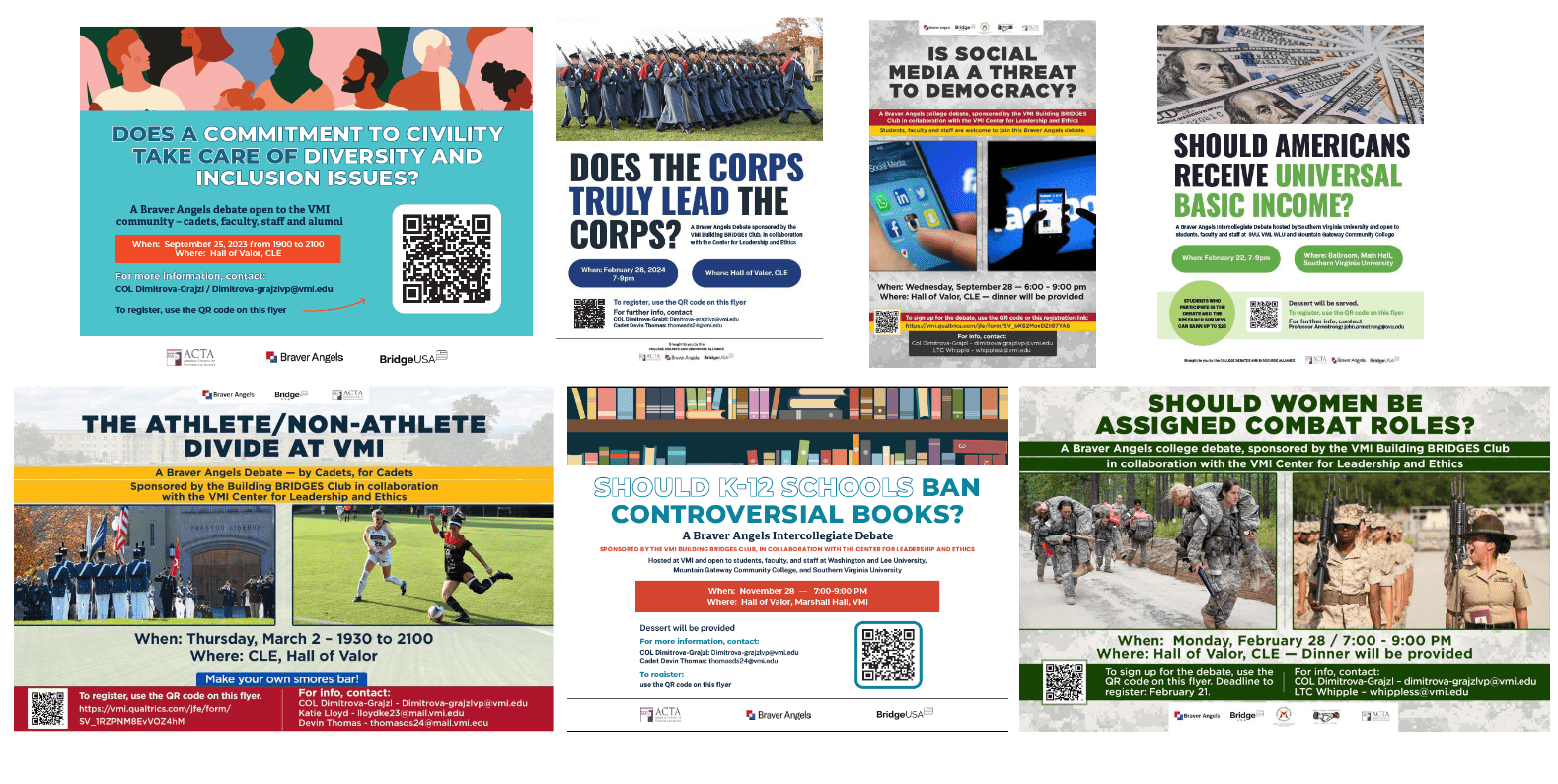
Figure 2
Image of Debate Setup: Participants Seated in Concentric Circles with Speakers in the Center